Cash Envelope Insert for Back-to-School Budgeting
Imagine this: It’s late July. You’re standing in the school supply aisle, cart half-full, scanning price tags while mentally subtracting from your grocery budget — and suddenly remembering you still haven’t paid for band camp fees, field trip deposits, or that $42 “required” art kit. Sound familiar? That’s where the Cash Envelope Insert steps in—not as a magic fix, but as a quiet, tactile anchor in the chaos of back-to-school planning.
What Is a Cash Envelope Insert—Really?
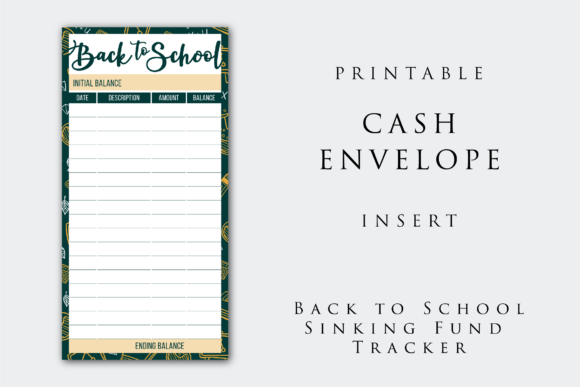
A Cash Envelope Insert isn’t a digital app or a spreadsheet tab. It’s a physical, printable tool designed to slide into a standard 3″ x 6″ cash envelope—the kind you might already use for groceries, gas, or dining out. This specific version is sized to fit three inserts per letter-size page (8.5″ x 11″), optimized for quick printing and immediate use. Each insert features clean labeling space, visual cues, and intentional white space—not to track every penny, but to hold intention. It’s not about perfection. It’s about creating a boundary between “I’ll figure it out later” and “This belongs *here*.”
Real-Life Moments Where It Makes a Difference
Consider Maya, a single mom of two middle-schoolers. She uses one envelope for “School Supplies,” another for “Extracurriculars,” and a third for “Lunch & Snacks.” Every Sunday evening, she pulls out her envelopes, checks balances, and adds only what’s needed—not what’s leftover. No spreadsheets open. No notifications buzzing. Just paper, pen, and presence.
Or think about David, a high school teacher who coaches cross-country. He manages team fundraising, uniform deposits, and competition fees across four seasons. Instead of letting those funds blur into his personal checking account, he assigns each event its own envelope—and uses the insert to note deadlines, contact names, and remaining balances. When the treasurer asks, “How much is left for the regional meet?” he flips open an envelope and knows instantly.
Even college students benefit. A rising sophomore used these inserts to separate “Textbook Fund,” “Transportation Pass,” and “Meal Plan Top-Ups”—all drawn from a part-time job. Because the inserts are non-editable and printed once, they created gentle accountability: no deleting entries, no “undoing” overspending. Just honesty with herself.
Who Gets the Most Out of This Tool?
- Parents juggling multiple grade levels: One child needs lab coats; another needs robotics club dues; a third needs field trip forms returned with cash. Three envelopes = three clear buckets—no mental juggling.
- Teachers and PTA volunteers: Managing class funds, fundraiser proceeds, or activity fees becomes less about trust and more about transparency—especially when receipts and inserts sit side-by-side in a shared binder.
- Students learning financial responsibility: Whether it’s a teen saving for prom attire or a college student budgeting for semester supplies, the physical act of placing cash in an envelope labeled “Backpack & Tech” builds awareness faster than any app notification.
- Small business owners running summer camps or tutoring programs: These inserts help separate operational costs (printing handouts, snack packs) from revenue collected—keeping books cleaner before tax season hits.
Practical Considerations Before You Print
Before hitting print, ask yourself: What’s my goal? If you’re hoping to replace your entire budgeting system, this isn’t the tool for that. But if you want something simple, screen-free, and grounded in real behavior—not theory—it fits beautifully.
Because this Cash Envelope Insert comes as a non-editable, non-fillable PDF, it encourages intentionality over convenience. You won’t be tempted to tweak categories mid-month or delete a “mistake.” Instead, you’ll make a conscious choice each time you print a new set. That small friction is by design—and it’s exactly why many users report fewer impulse overspends.
Printing matters, too. Use the “actual size” setting (not “fit to page”)—otherwise, the 3″ x 6″ dimensions shift, and your inserts won’t slide neatly into standard envelopes. Adobe Acrobat Reader is recommended because it honors embedded sizing instructions better than most browsers or preview apps. And yes—colors may vary slightly between your screen and final print. That’s normal. What matters is legibility and usability, not Pantone precision.
Strengths You’ll Feel Right Away
The biggest strength isn’t visual—it’s psychological. Seeing “$78.50 left for School Photos & Yearbook” written by hand on an insert creates a different kind of awareness than seeing the same number buried in a bank app. There’s weight to it. There’s ownership.
It also works offline, across devices, and without passwords. No updates. No subscriptions. No syncing errors. Just you, your printer, and three envelopes waiting to be filled.
And because it’s designed specifically for back-to-school timing, the layout anticipates common line items: supply lists, permission slips, transportation passes, instrument rentals, spirit wear orders—even “teacher appreciation gifts.” Nothing’s prescriptive, but everything feels familiar.
Where It Might Not Fit (and That’s Okay)
This isn’t ideal if you prefer fully automated tracking or need real-time collaboration across five family members’ phones. It also doesn’t include built-in calculators or recurring reminders—those live outside the tool, in your habits and routines.
Some users initially miss the ability to edit digitally—but most discover that limitation becomes a feature. Without the option to “fix it later,” they plan more thoughtfully upfront. One homeschooling parent told us, “I used to over-print supplies ‘just in case.’ Now I wait until the list is final—and only print what I need.”
How to Make It Work With Your Life—Not Against It
You don’t need to go all-in on day one. Try one envelope first: “Back-to-School Basics.” Fill it with cash only after reviewing your supply list and comparing prices at two stores. Keep the insert visible—taped to your fridge, clipped to your planner, or tucked into your wallet. Let it serve as a checkpoint, not a cage.
If you're printing at home, choose a slightly heavier paper (like 24–28 lb) so the inserts hold up through weekly handling. For professional printing, request matte finish—glossy surfaces can smudge ink when handled often.
And remember: The goal isn’t zero overspending. It’s clarity. It’s reducing decision fatigue when you’re already tired. It’s giving your future self a version of you that showed up prepared—not perfect, but present.
Why This Fits Into Bigger Financial Habits
Using a Cash Envelope Insert doesn’t exist in isolation. It often becomes the first step toward more intentional spending—or the stabilizing piece in a hybrid system (e.g., digital income tracking + physical expense containment). Teachers use it alongside school finance software. Parents pair it with shared Google Sheets for long-term goals. Students layer it over their first real bank account.
What stays consistent is the rhythm: review, allocate, label, place, reflect. That rhythm builds muscle memory far faster than any tutorial video. And when September rolls around—not with panic, but with calm readiness—that’s the real return on investment.